It’s not perfect by any means, but the new Archives museum remains a fabulous advance in archival access for everyone.
By: Charles Francis
The Archivist was dismissed. It was both swift and shocking when Dr. Colleen Shogan, the 11th Archivist of the United States, was abruptly fired last year by Donald Trump with no reason given.
It was especially shocking since, as archivist, it had fallen to Dr. Shogan to defend the Presidential Records Act of 1978 and to retrieve fifteen boxes of government records that had been taken to Mar-a-Lago. This was her fate, but all of us who love the National Archives and Records Administration (NARA) and what it represents suffered. “Study the Past” (don’t stash it at former Presidents’ homes) is the classical inscription on the National Archives’ wall.
Pinioned by our shock and helplessness, we recently decided to revisit the National Archives and its new museum to see the interactive, AI-powered exhibition of historic images and documents titled “The American Story.” We wondered what documents and people might be deleted for being too “woke” or too gay or queer by the new team at the Archives.
We had heard there were keyword-based searches and programs slashed for all things tagged “homosexual.” So, we looked throughout the exhibition’s nine galleries for any mentions of gay pioneer Dr. Franklin Kameny and our legacy organization, the Mattachine Society of Washington, DC. We figured the keywords “Kameny” and “Mattachine” would be good telltales of erasure.
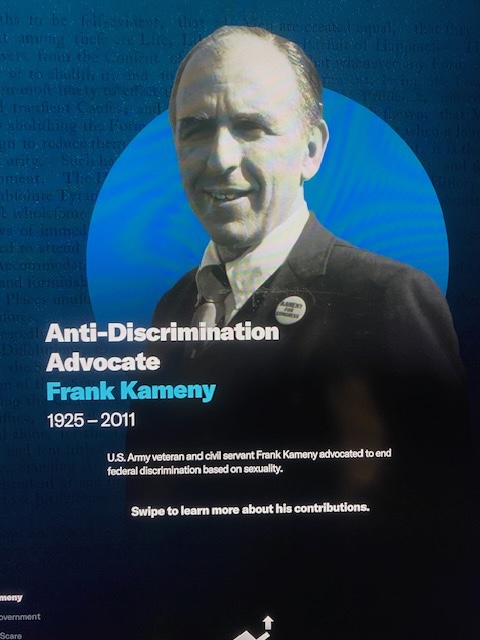
So we were pleasantly surprised that Kameny made the cut. How could this have happened? Under the heading “Exceptional Americans in the Records”, Kameny has his own page on a large digital kiosk with a drill-down of historical documents. He would be thrilled to know the graphic image of this section is a portrait of Benjamin Franklin.
Even so, Kameny is straightwashed. His NARA descriptor? He was an “Anti-Discrimination Advocate.” His defining self-description back in the day was “homosexual militant.” Maybe the lite descriptor was what it required to get this anti-discrimination advocate past the politics, sieves, and screens.
When I arrived, the Archives team patiently taught me how to personalize my experience in the galleries with a barcode to select an icon. I chose the White House illuminated with the colors of Pride, captioned “The White House After Obergefell v. Hodges,” with my chosen interest matches being “Court Cases, Rights, and Politics”.
It was like an archival Grindr, and at least the AI bot knows I am gay. I selected the Obergefellicon because the new Mattachine Society filed an amicus brief in support of same-sex marriage in the Obergefell case. So with my barcode, I explore the maze of displays that draw upon some two million records.
Seeing the “Exceptional Americans” kiosk, I thought, let’s give it a try. Why not? Kameny was certainly exceptional. I scanned my barcode, and boom! There’s Kameny alongside icons of Mark Twain and Henry Kissinger for God’s sake. How that happened, who can know? Perhaps an AI hallucination, but there he was.
I swiped a sidebar and up came “Federal Government”, “Lavender Scare,” “Kameny Appeals,” “Advocacy,” and “Legacy.” I drilled down and explored the relevant documents, such as Kameny’s historic petition to the Supreme Court to review his dismissal from the Army Map Service because he was homosexual.
“In World War II, Petitioner did not hesitate to fight the Germans with bullets”, he wrote, “in order to preserve his rights and freedoms and liberties and those of others. In 1960, it is ironically necessary that he fight the Americans with words in order to preserve, against a tyrannical government, so many of those same rights, freedoms and liberties for himself and others.” (Petitioner Franklin E. Kameny v. Brucker, Secretary of the Army et al, 1961).
60 years later, we are still there, fighting our fellow Americans with words. The political and verbal assault against LGBTQ+ Americans continues with gale force.
Of the thousands of pages of documents donated by Kameny to the Federal Government – the Library of Congress, the Archives and elsewhere – his eloquent petition written and submitted “pro se” (by himself), was “the first Supreme Court petition ever written against the federal government’s gay purges”, writes Eric Cervini, author of the Pulitzer Prize finalist, “The Deviant’s War: The Homosexual vs. the United States of America”.
One may now download all of this information onto an iPhone to create “portable mini-archives,” thanks to Microsoft AI and the Archives. We “archive activists” love what AI can do for citizen researchers to obtain and explore documents according to our interests. Goodbye to months of searches or waiting in line for hours or days at the Archives in Washington or College Park, Maryland.
That Kameny is included as part of the American story in some way vindicates what he fought for. The struggle for LGBTQ+ equality has long been an integral part of our nation’s history. Despite the drama at the Archives, this new museum is a fabulous advance in archival access for everyone.
Article originally posted on LGBTQNation on May 6, 2026.






 Charles Francis